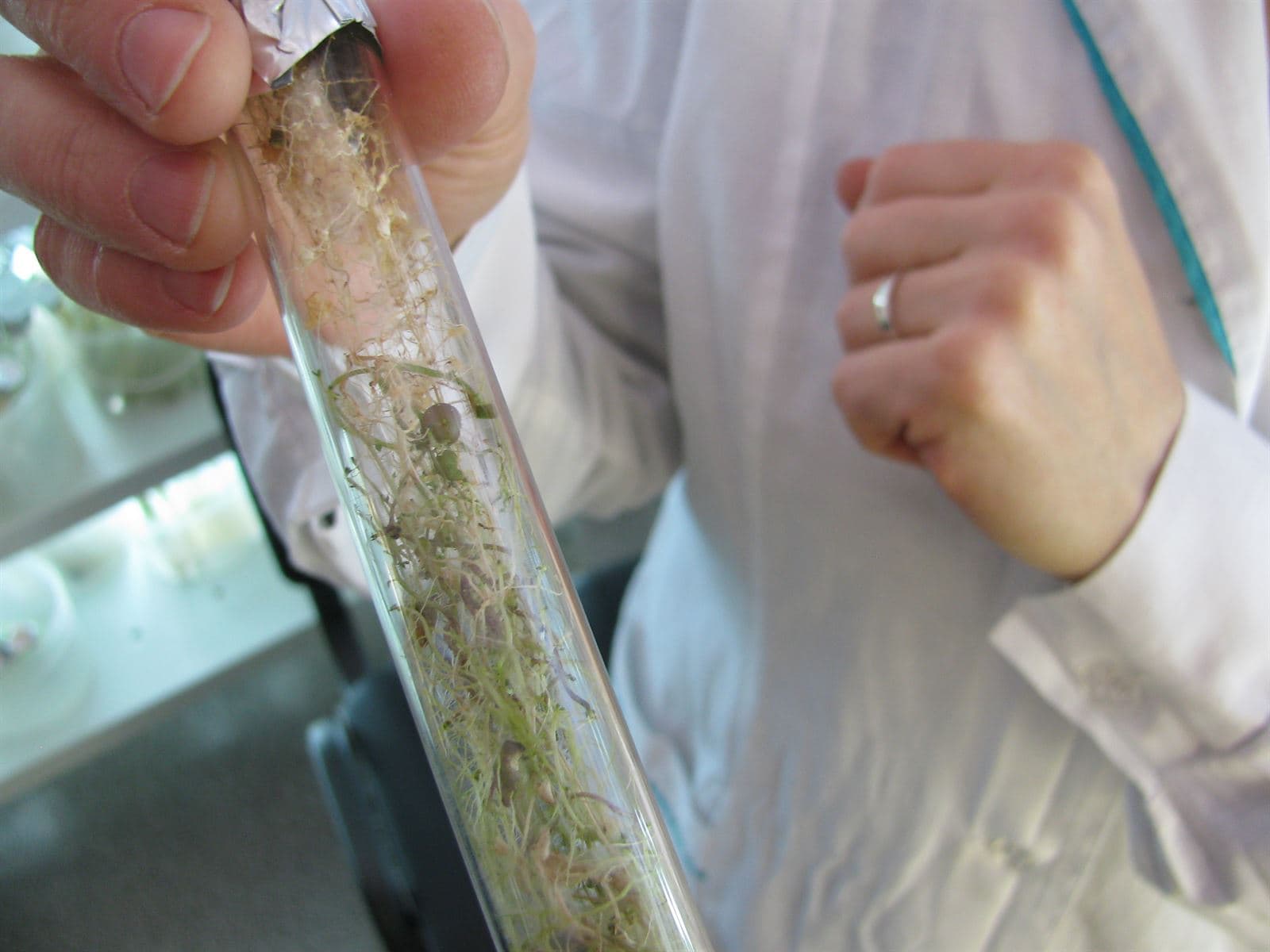
The science behind
every jar.
Tissue culture isn't magic — it's chemistry, cellular biology and a chain of reproducible decisions. This is the no-frills version.
From field to jar
without losing a colony.
If a single bacterium enters the jar, in 72 hours the medium is a cloudy soup. Every step of the chain exists to prevent that.
- 01CollectionHealthy explant
Meristematic or nodal tissue — the youngest and cleanest the donor plant can give.
- 02SterilizationHypochlorite + surfactant
Hypochlorite with surfactant at concentration adjusted per species. Immersion time variable by tissue rigidity.
- 03Laminar hoodHEPA-filtered air
Laminar flow with HEPA-filtered air. Instruments flame-sterilized between every transfer.
- 04InoculationMS basal medium
Transfer into the jar with gelified nutrient medium. Seal allowing controlled gas exchange.
- 05Growth chamberControlled photoperiod
Temperature, photoperiod, spectrum and intensity calibrated per stage.
The medium decides
what the plant does.
Murashige & Skoog basal salts, per-stage hormonal tweaks and a pH of 5.8 that feels trivial — until it moves the response from 10 to 85%.
Same MS, different stage, different plant.
Murashige & Skoog 1962 basal salt is the backbone. On top of it we layer auxins, cytokinins, vitamins and sugars in stage-specific combinations.
The auxin/cytokinin ratio decides whether the cell grows as a shoot, a root, or as disorganized callus. What you see on the side is the base recipe we kick off almost every protocol with.
- We tune per species using dose-response titration
- We document every batch with batch number and measured pH
- Final sterilization via autoclave / pressure cooker
From explant to plant
in five leaps.
Every stage has its conditions, its success indicators and its particular ways of failing. Serious micropropagation starts with knowing how to diagnose.
Establishment
The explant enters the system. Sterilization, oxidation assessment and initial medium response.
- Medium
- MS + low cytokinin
- Light
- Controlled photoperiod
- Time
- 10–21 days
Bacterial / fungal contamination · phenolic oxidation
Multiplication
Activation of axillary meristems. The tissue goes from 1 shoot to 5–30 per subculture.
- Medium
- MS + elevated cytokinin
- Subculture
- Periodic
- Ratio
- ×3 to ×10 per cycle
Hyperhydricity · somaclonal variation · unwanted callus
Rooting
The shoot is separated and transferred to medium without cytokinins, with mild auxin. The functional root system appears.
- Medium
- ½ MS + mild auxin
- Charcoal
- Dosed
- Time
- 14–28 days
Vitrified root · absence of secondary roots
Acclimatization
The plantlet leaves the jar onto solid substrate. Humidity drops gradually; stomata learn to regulate.
- Substrate
- Calibrated per species
- Humidity
- Controlled ramp
- Time
- 10–14 days
Hydric shock collapse · direct-light scorching
Hardening
Final transition to greenhouse conditions. The plant gains cuticular wax and becomes commercially viable.
- Light
- 100% ambient
- Watering
- normal routine
- Time
- 21–45 days
Pests (thrips, mites) · nutrient deficiencies
The curve that saves the batch.
In vitro plants have lazy stomata and almost no cuticular wax. Pulling them into ambient conditions without transition kills them in hours.
The ramp on the right is our median line for Philodendron-style tropicals. It changes per species, but the general shape doesn't.
Acclimatization · 14 days
relative humidityRecommended humidity ramp. Aggressive transition collapses stomata; slow transition invites pathogens. This is the median line of our batches.
Introduction to In Vitro.
On-demand. Your own lab.
Two professional pre-recorded videos filmed in a real lab. Instant access when you buy. Lifetime access.